
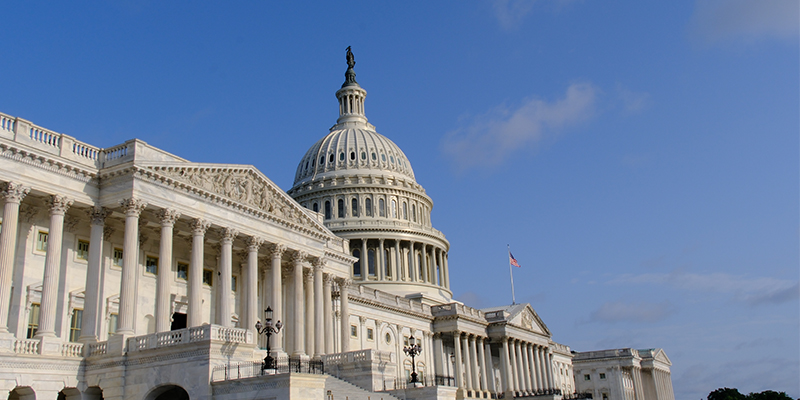
Last weekend, House Speaker Mike Johnson (R-LA) and members of his leadership team retreated to Camp David with a number of GOP members to discuss strategies for advancing a third budget reconciliation bill. Republicans hold a narrow majority in the House, with 219 Republicans, 215 Democrats and one independent. In the Senate, Republicans hold a 53-47 majority, but 60 votes are needed to overcome an opposition filibuster effort that would block legislation from advancing. But Senate procedures make a budget reconciliation bill immune to a filibuster, allowing it to advance legislation with a simple majority vote. As a result, congressional Republicans and the administration have spent much of this Congress relying on budget reconciliation as a means of advancing priorities through the Senate.
Congressional Republicans were relatively successful in using reconciliation to pass major tax legislation last summer as well as funding for the Department of Homeland Security, which ended the partial government shutdown earlier this spring. Now, they are pursuing a third reconciliation bill. President Donald Trump would like to use it to fund his Department of Defense spending priorities, while House Speaker Mike Johnson has promised to include election security measures from the SAVE America Act.
Budget reconciliation was never intended to be the legislative tool it has become today. It was originally created as a procedural mechanism to help Congress align spending and revenue with its overall budgetary framework.
Over the past several decades, however, increasing political polarization and the Senate’s 60-vote threshold for overcoming a filibuster have transformed reconciliation into the primary vehicle for advancing partisan priorities.
While President Ronald Reagan used reconciliation during his first term to pass his Economic Recovery Tax Act of 1981, the first major partisan use of reconciliation (with the president and both chambers of Congress held by the same party) occurred in 1993, when President Bill Clinton and congressional Democrats passed the Deficit Reduction Act. President George W. Bush and congressional Republicans later used the process to enact the Economic Growth and Tax Relief Reconciliation Act in 2001 and the Jobs and Growth Tax Relief Reconciliation Act in 2003. Divided government largely sidelined the process until 2010, when President Barack Obama and congressional Democrats used reconciliation to pass portions of the Affordable Care Act. It was later used in 2017 by Trump and congressional Republicans to pass the Tax Cuts and Jobs Act in his first term.
The process gained even greater prominence during the 117th Congress, when President Joe Biden and congressional Democrats successfully used reconciliation twice: first for the American Rescue Plan in 2021 and then for the Inflation Reduction Act in 2022. Not to be outdone, Trump and congressional Republicans passed the One Big Beautiful Bill Act last year and, in June, used reconciliation to fund the Department of Homeland Security and end the partial government shutdown.
Johnson is now directing Republican members of the House Budget Committee to advance a third reconciliation package before the August recess. The bill is expected to include $67 billion in supplemental funding for military operations in Iran, and Trump has requested $350 billion to cover the remaining FY 2027 Department of Defense budget request, that was not included in the regular appropriations process. Johnson is also exploring ways to incorporate provisions from the SAVE America Act.
This will be a significant challenge because reconciliation may only be used for three purposes: spending, revenue (taxes) and the debt limit. The Senate’s Byrd Rule imposes a “mere incidental” test, requiring that a provision’s budgetary impact be its primary purpose rather than a byproduct of a broader policy change. To address this limitation, House Republicans are proposing a $4 billion grant program designed to incentivize states to verify voter identification and citizenship.
The reported total for new spending in “Reconciliation 3.0” could exceed $420 billion. Although House Republicans have proposed offsetting a portion of that spending with fraud-reduction reforms in Medicare, Medicaid and other federal assistance programs, those savings are unlikely to fully cover the cost. In previous reconciliation efforts, both the Biden and Trump administrations proposed reforms to Section 1031 like-kind exchanges and carried interest provisions as ways to increase federal revenue. These tax provisions are critically important to the commercial real estate industry, and CREDA’s Federal Affairs team has successfully advocated for their preservation in prior negotiations.
The recent passing of Senate Budget Committee Chairman Lindsey Graham (R-SC), the illness of Senator Mitch McConnell (R-KY) and resistance from Senate appropriators all present significant obstacles to Reconciliation 3.0. In addition, there are fewer than 25 legislative days remaining in the 119th Congress before the Nov. 3 midterm elections. During this critical time when events can move rapidly, CREDA’s government affairs team is taking nothing for granted, and will continue working to ensure that revenue provisions harmful to commercial real estate are not included in any emerging tax and spending bill.