
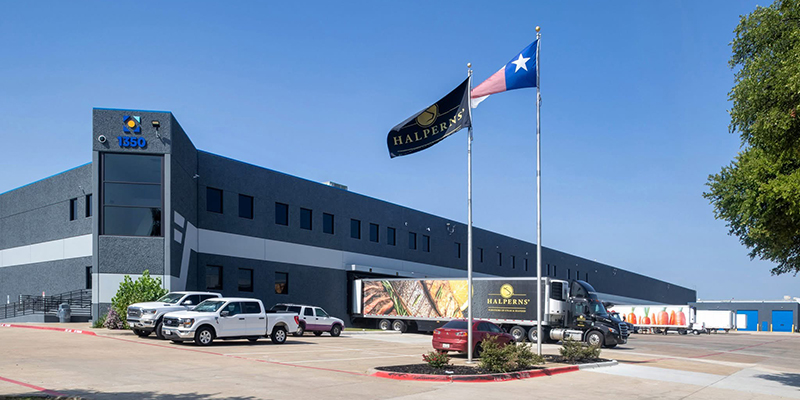
Attendees at the I.CON Cold Storage conference this week toured a facility that illustrates one of the sector’s more compelling challenges: converting a decades-old bulk storage shell into a fully operational, USDA-compliant food processing plant.
The Alston Construction team led the tour of the 63,500-square-foot Halperns’ Steak and Seafood facility in Arlington, Texas, and Todd Williams, general manager for Halperns’ Texas, walked attendees through the frigid rooms filled with everything from dry-aged ribeye to colossal tuna.
Constructed in 1987, the facility has cycled through a notable list of tenants – Martin Brower ran McDonald’s northern Texas distribution from the building for roughly two decades, followed by Hello Fresh and Blue Apron. Alston was originally brought on by ownership group Longpoint to renovate and update the existing shell. When Halperns’ – a subsidiary of Gordon Food Service – selected the building for its new Texas operation, Alston was awarded a separate tenant improvement contract to convert the shell into a working processing plant. Rather than demolish and rebuild, the Alston team reconfigured a building designed for bulk storage into a facility that meets USDA processing standards.
Designing for USDA Compliance
Every wall, floor, door and drain in the facility was designed around USDA compliance – sloped floors, coved corners and wash-down doors throughout. The facility supports two parallel product lines, meat and seafood, each with its own dock, storage area and processing path that converge near the finished goods area, minimizing opportunities for cross-contamination between product types.
That attention to separation extends to individual rooms. When an attendee asked why meat, shellfish and fresh fish are each held in separate areas despite being stored at the same temperature, Williams had a ready – and personal – answer: cross-contamination prevention. He would know; Williams has a shellfish allergy.
The Scale of the Operation
Halperns’ is a roughly $1.2-billion company headquartered in Atlanta, with seven processing plants nationwide, including locations in Florida, Maryland, Michigan and Kentucky. The Texas facility is the company’s westernmost plant and represents a significant leap for the local operation, which had previously worked out of an 18,000-square-foot building.
The numbers at the new facility underscore that growth. Approximately 50,000 pounds of product ship out each night to the clients they serve in the region. At any given time, the facility holds roughly $6.5 million worth of product – a figure that climbs to $10.5 million during the holiday season. The two USDA inspectors that visit the plant twice daily keep a close eye on things.
Redundancy as a Design Principle
Williams shared an industry saying that captures the importance of precise temperature control in the facility: “Life begins at 40.” In other words, at 40 degrees Fahrenheit, bacteria growth accelerates, so Halperns’ keeps its facilities below that threshold throughout. Each room can run on just one or two Freon refrigeration units, but four or more are installed in every room, ensuring operations continue uninterrupted if a unit fails.
One of the more memorable features on the tour: two 2,500-gallon lobster tanks, each capable of holding approximately 2,000 live lobsters, supporting the facility’s role in supplying high-end restaurants and specialty retailers.
A Study in Tenant-driven Design
For tour attendees, the Halperns’ facility offered a tangible look at what it takes to adapt cold storage space for a highly specialized end user. The project required close coordination between developer, contractor and tenant to layer USDA-grade infrastructure, redundant mechanical systems and specialized features like the lobster tanks onto an existing shell – all while keeping the building’s products carefully separated.
For developers and owners evaluating older bulk storage assets, the Halperns’ conversion makes the case that with the right tenant partnership, even a decades-old shell can support one of the industry’s most demanding end uses.