In 2014, Denver’s iconic Union Station was brought back to life through a $55 million public-private revitalization effort, turning the formerly neglected landmark into a dining and retail hub. Ten years later, $12 million was invested in renovating the station’s Great Hall and the guest rooms in the luxury boutique Crawford Hotel, located on the station’s upper floors.
Eighty trains per day passed through Union Station in its heyday. That is no longer the case; just two Amtrak trains make stops daily. But the station is still a transit hub, offering light-rail service to and from Denver International Airport as well as bus service throughout the metro area. It also serves as a stop on the free bus service that runs the length of downtown’s 16th Street.
The city of Denver and RTD (Regional Transportation District), which owns the property, awarded the revitalization project to the Union Station Alliance, consisting of Sage, Urban Neighborhoods, McWhinney, REGen LLC, and Larimer Associates in 2011.
Ed Blair, area general manager for Sage Hospitality, which manages Union Station, recalled when he used to commute through the station and its ceiling was falling in. “To see the transformation that has happened to this property and this part of the city… is pretty remarkable,” he told CREDA Conference attendees who took part in a walking tour of Denver’s downtown area.
Consider that more than 10,000 people now pass through Union Station each day. It is also a popular gathering place, with Blair noting it is sometimes referred to as “Denver’s living room.” In fact, the revitalization of Union Station is largely credited with breathing new life into Lower Downtown, known as LoDo.
But as Andrew Iltis pointed out on the next leg of the tour, this success story is uneven. While LoDo is flourishing, including attracting more residential development, Upper Downtown (the northern part of what was once referred to as the central business district) is not, with office vacancy around 40%. “It’s the story of two downtowns,” said Iltis, senior vice president of planning and community impact at Downtown Denver Partnership. “Our vision is to mimic and bring the story of LoDo to Upper Downtown.”
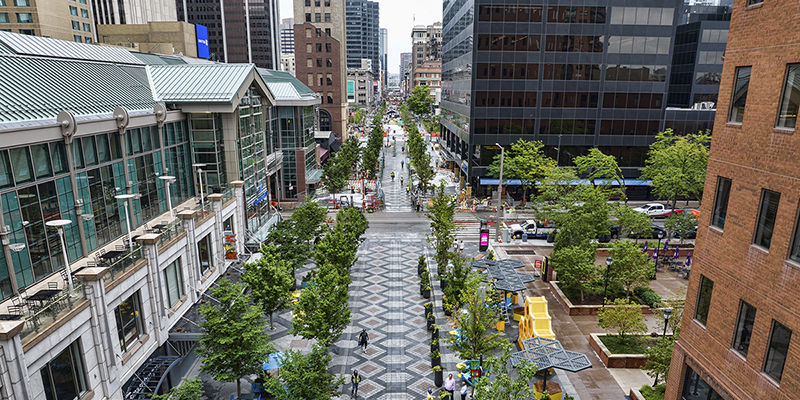
Part of that effort involved the $175 million multiyear project to revitalize 16th Street, a pedestrian-friendly avenue that fully reopened last October. The 16-block project addressed improving safety, mobility and infrastructure, and reconfiguring sidewalk and transit service to create a more welcoming public realm.
Downtown Denver Partnership is also involved in helping to reimagine the three blocks of Skyline Park along Arapahoe Street, including a portion at the 16th Street pedestrian corridor. The desire is to reconnect the park’s blocks and activate them with more cultural activities and opportunities for social connection.
Iltis pointed out a recent small example of transforming the blocks: a large-format screen attached to a building and funded by the Denver Theatre District. In time, the screen may host interactive games or show concerts at Red Rocks, adding more life to the area. Block 2 of the revitalization, due to be completed next year, will include splash pads, a water feature and beer garden-style kiosks, among other features. A central plaza and stage will support year-round programming.
Iltis said Downtown Denver Partnership realized there wasn’t enough energy in the market to change the entire Upper Downtown area at once. Instead, the organization has identified “catalytic nodes” that might lead to additional investment.
One of those nodes is Glenarm Plaza, a food market and public plaza on 16th Street with open-air seating. In the wake of the COVID-19 pandemic, Iltis said, an idea was raised: “Let’s see what happens if we start activating this space. Sure enough, people started to gather.” Eventually, the plaza became one of the locations for the “Skynets Over Downtown” temporary art installation.
Glenarm sits across from the Denver Pavilions, a three-level, open-air shopping, dining and entertainment center built in 1998. The pandemic and the long-term construction along 16th Street proved to be something of a one-two punch for the Pavilions, which is about 65% occupied currently, said Kim Sperry of Sperry Advisory, a consultant for the Denver Downtown Development Authority.
The development authority, which initially formed to help support the revitalization of Union Station, bought Denver Pavilions from its previous owner at the end of 2025 for $45 million. It also acquired two on-site parking lots from Brookfield Properties for $23 million, which has created the potential for a large-scale mixed-use development in the future, Sperry said. “The true redevelopment potential is on those parking lots,” she added.
The current vision involves vertical development, whether multifamily or a hotel, that also incorporates back to retail at the Pavilions. In the meantime, the development authority is still focusing on day-to-day operations at the Pavilions and making ongoing capital investments, including in underground parking. This past September, Denver artist Olive Moya completed a 47,000-square-foot mural – one of the largest in Colorado – on one side of the Pavilions.
“We’re bullish on downtown,” Sperry said, “but it’s going to take a little bit of time.”
The walking tour ended at Populus, a luxury boutique hotel completed in Upper Downtown in 2024. Created by Urban Villages, it stands as the country’s first carbon-positive hotel. The distinctive exterior design, which mimics Colorado’s native aspen tree, is from architecture firm Studio Gang and was led by MacArthur Fellow Jeanne Gang.

This post is brought to you by JLL, the social media and conference blog sponsor of the CREDA Conference 2026. Learn more about JLL at www.us.jll.com or www.jll.ca.