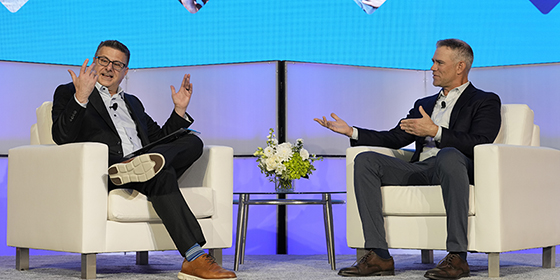
Theo Epstein built championship teams in two of baseball’s most demanding markets, ending long title droughts with the Boston Red Sox in 2004 and the Chicago Cubs in 2016. In a keynote conversation with CREDA President and CEO Marc Selvitelli, CAE, at the CREDA Conference in Denver, the Fenway Sports Group senior advisor and former president of both clubs shared lessons on leadership, data and developing the neighborhoods around ballparks.
Look Through More Than One Lens
Early in his career with the San Diego Padres, Epstein worked between an old-school scouting director who only wanted to watch players and the team’s lone statistician, who only wanted to run numbers. He learned from both and concluded that the clearest way to predict performance is to combine the two.
Analytics eventually took over the industry, but Epstein cautioned against taking it too far. Players aren’t simply the output of a model, he said, and relying only on numbers – in any industry – dehumanizes the process. With the Cubs, getting to know and support players proved a bigger advantage than any statistical breakthrough.
Tough Calls, Transparency and Trust
Epstein called trading franchise icon Nomar Garciaparra in 2004 the hardest decision of his Red Sox tenure. The move drew a public outcry, but the team went on to win the World Series.
Leaders can’t sell a controversial decision in the moment, he said. It depends on the trust and relationships already built, and on getting everyone behind the organization’s vision. Part of the job is doing what’s right for the organization, even when it’s unpopular or carries personal risk.
In Chicago, Epstein wrote a five-year plan and shared it openly with fans, including that familiar players would be traded. Planning for the future while selling the present doesn’t work, he said, because fans see through it. He also warned against rushing a long-term plan: a short-term fix can undo many good decisions. To guard against that, he kept disciplined long-term thinkers in his inner circle to push back.
Lessons from Fenway and Wrigley
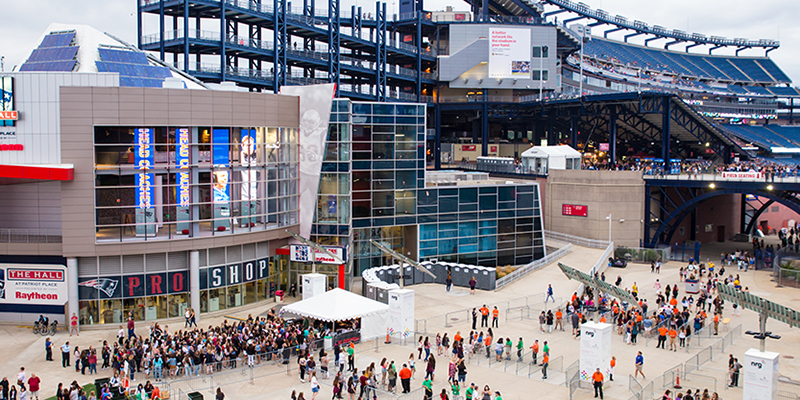
Epstein worked at MLB’s two oldest ballparks – Fenway Park (1912) and Wrigley Field (1914) – both embedded in neighborhoods. Wrigley’s residential setting limits the Cubs to 30 night games a year, a constraint Epstein accepted since the neighbors were there first.
Rather than replace either ballpark, ownership renovated both so new features looked as if they had always been there. The same principle should guide surrounding development, he said: it must honor the authenticity of the experience. Chasing trends can bring the wrong kind of commercial tenants, leading to turnover that cheapens the area.
The biggest opportunity – and challenge – is drawing people on non-game days. Enhancing game day is the easier part, Epstein said, and both organizations had hits and misses.
Timing matters, too. Wrigley’s redevelopment benefited from a favorable environment, while Boston’s ambitious plans stalled when a less development-friendly mayor took office and interest rates shifted. When macro trends are involved, he said, timing can’t be forced.
Closing the conversation, Epstein shared his favorite moment of the 2016 title run: during a rain delay in Game 7 of the World Series, after Cleveland tied the game, the players crammed into a small weight room for a team meeting instead of retreating to their lockers. The Cubs went on to win. For Epstein, it reflected years of building trust and integrity – a connection that can’t be faked.

This post is brought to you by JLL, the social media and conference blog sponsor of the CREDA Conference 2026. Learn more about JLL at www.us.jll.com or www.jll.ca.