
For most of the past two decades, power was the easy part of industrial deals. Developers could simply obtain a will-serve letter from the utility and move on. As a CREDA Conference session on the ways power constraints are reshaping industrial development made clear, that era is over.
Panelist Mehul Desai, project executive at Saxum Real Estate, framed the problem with two numbers. U.S. power demand grew just 0.1% to 0.2% per year from 2005 to 2020; since 2020, it has grown 1.7% to 2% a year. And while the country has installed roughly 1,200 gigawatts (GW) of capacity over the past century, applications for about 2,300 GW are pending for the next five years.
“In the data center world, we’re dealing with things a gigawatt and above, but we also have significant power issues in the 3- to 5-megawatt range as well,” noted moderator Pat Lynch, executive managing director and global leader for CBRE’s data center and digital infrastructure business.
Four Lessons from the Panel
1. A will-serve letter is not a guarantee. Desai recalled a project Saxum Real Estate was doing in Jacksonville, Florida, with a will-serve letter in hand from the utility company. But one day he received a call from the general contractor (GC). “He said, ‘You know, I think we have an issue. … We’re not going to have the transformer for two years.’” The utility wouldn’t allow the team to source one from elsewhere, even when Saxum offered to pay for testing that met the utility’s standards. “We were basically stuck,” Desai said. “We had to have the GC demobilize for about seven to eight months and had to remobilize after that, and we finally finished the project.” Construction material shortages have eased, he noted, but power equipment lead times have held steady or gotten worse. Saxum now tells brokers not to bring sites without a solid, written power plan.
2. Flexibility buys speed. Panelist Dave Mullaney, chief transformation officer at trucurrent, a developer, owner and operator of behind-the-meter energy resources, pushed back on the doom-and-gloom narrative surrounding power. He pointed out that the grid is short on capacity at its worst hours, not on average. “We’re starting to see a lot of utilities, particularly on the coasts, like in California, New York, Connecticut, Massachusetts, come out with this idea of flexible interconnection,” he said. A site that can’t curtail its usage might only get 1 MW, while those that agree to stay off the grid during peak stress might get 3 to 4 MW. “And that can make a huge difference in what types of uses can exist at a site,” Mullaney said.
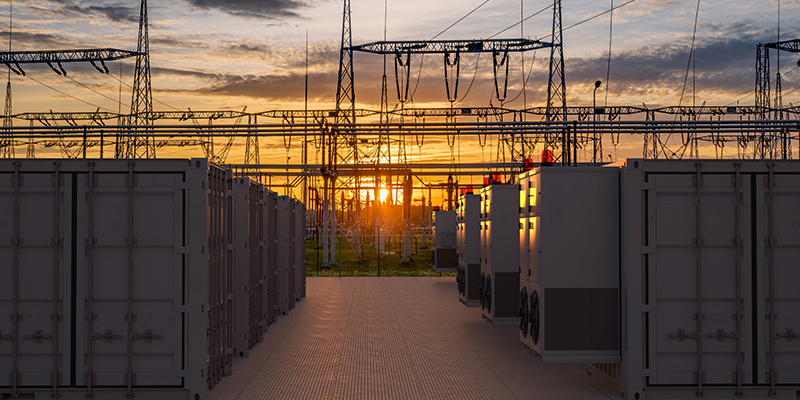
With a client last year, trucurrent offered to bring batteries to its site, get it on a flexible interconnection and secure the company power two years earlier than it otherwise could. Mullaney said they told the client, “When the grid gets to be strained and needs you to get off, just … pull power from the battery instead of pulling power from the grid. We found that created a really significant speed-to-power advantage for this client that needed it for EV charging purposes.” The battery capability gets called on two or three times a year; the rest of the time it cuts demand charges and arbitrages time-of-use rates for the client, Mullaney explained.
3. Smaller loads can earn from bigger loads. Some hyperscalers can now meet interconnection requirements by paying other users to get off the grid for them, Mullaney said. That means a 1 to 5 MW industrial site with a battery could host capacity for a 500 MW data center and collect lease payments for it. “If you’re willing to be flexible with your load or bring assets that can create flexibility without introducing operational disruption, there’s a whole set of value propositions that are now opening up that previously just didn’t exist,” he said. “They can generate lease payments, they can generate electricity bill savings, they can generate speed to power.”
4. The queue will stay long. Panelist Sarah Orban Salati, chief commercial officer, large load power solutions for National Grid Ventures, expects interconnection to remain a challenge at both the utility and grid-operator levels. Utilities are asking for more skin in the game, such as deposits, proof of site control and minimum demand charges, to weed out speculative projects. Transformers, turbines, construction firms and skilled labor are all in short supply, she noted, and every sector is competing for them. Community backlash against data centers is also raising scrutiny of everything else being built.
What it Means for CRE Professionals
Power is becoming a value driver. A building with 3,000 amps commands different rents than one with 300, Mullaney said. A site that goes from 500 kW to 4 MW through flexibility could shift from warehouse to small data center. That value increasingly accrues to the landowner, not just the occupier paying the electric bill.
Solutions are regional. On-site batteries, bridge power, fuel cells and solar all belong on a developer’s radar, but nothing is a silver bullet, Mullaney said. A fuel cell that saves money in one market can be a costly mistake where gas is expensive and electricity is cheap. He expects the grid tightness that’s now seen on the coasts will spread nationwide, along with rate structures that reward flexibility and penalize peak demand.
Start earlier and get more fluent. Engage utilities as early as possible, coordinate the energy timeline with the facility timeline, and choose experienced power partners. Developers may even need to follow grid-operator activity and state utility commission proceedings. Also look for competition. In Atlanta, Desai found two utilities competing for his project and promising to expedite transformers.
The Bottom Line
Despite the headlines, power constraints aren’t only a data center story. Every industrial project now competes for the same grid capacity, equipment and labor. Panelists suggested that the developers who come out ahead will treat power as a first-order site criterion, plan for flexibility from day one, and see energy as a potential source of revenue rather than only a cost.

This post is brought to you by JLL, the social media and conference blog sponsor of the CREDA Conference 2026. Learn more about JLL at www.us.jll.com or www.jll.ca.