
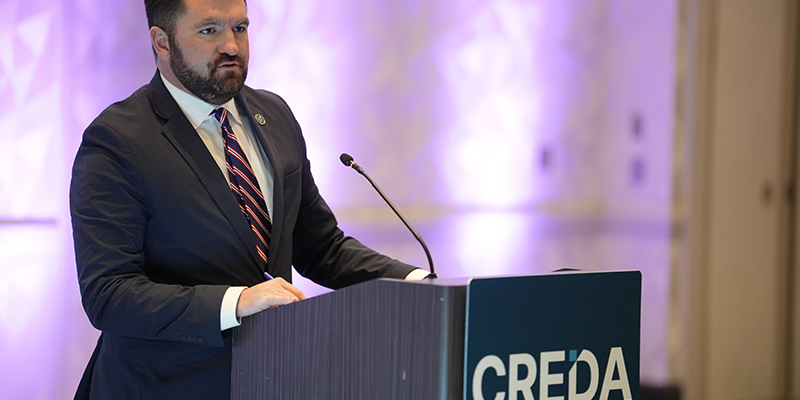
Energy policy, building codes and the nation’s growing demand for electricity are creating both challenges and opportunities for commercial real estate. At the Commercial Real Estate Development Association’s Board of Directors meeting this week in Denver, Michael Sangaline, senior advisor in the U.S. Department of Energy’s (DOE) Office of Critical Minerals and Energy Innovation, outlined several DOE initiatives with direct implications for developers, building owners and the broader real estate industry.
“I wanted to be here in person to make you aware of a few efforts underway at DOE that have the potential to positively impact and support the real estate industry,” Sangaline told the board.
His remarks focused on three areas: building energy codes and performance standards, voluntary programs such as ENERGY STAR, and efforts to address large energy loads, including data centers.
The cost of building performance standards
Sangaline highlighted the uncertainty surrounding the costs of complying with building performance standards, noting that retrofit cost data is often limited, varies significantly by location and can be unreliable.
He pointed to Colorado as an example. DOE and the national laboratories recently conducted a new analysis of the state’s building performance standards using more current retrofit cost data and leveraging artificial intelligence. The analysis estimated total first costs of $3.3 billion to $6.1 billion – significantly higher than previous state estimates.
“These ranges demonstrate the need for better, more transparent data on building retrofit costs,” Sangaline said. “Uncertainty in costs can have a large impact on the affordability of buildings.”
He also cited the Sheraton Denver Downtown Hotel – the host hotel for the CREDA Conference – where information shared in a recent court case estimated $23 million in building upgrades to comply with Energize Denver.
For policymakers, Sangaline said the answer is greater research, cost data collection and technical analysis before policies are adopted. “Transparency around these considerations is essential in the deliberation process,” he said.
Balancing efficiency, affordability and choice
Sangaline also discussed DOE’s work analyzing the costs of updated building energy codes. The department and national laboratories recently analyzed the 2024 International Energy Conservation Code and found that wholesale adoption for residential buildings could increase construction costs across states by more than $57 billion.
DOE is conducting similar analyses for commercial and multifamily buildings, as well as more stringent local “stretch” codes.
Sangaline outlined three principles guiding DOE’s approach: base model codes should focus on cost-effective and technologically feasible energy efficiency; efforts that go beyond those codes should be voluntary and market-driven; and codes and standards should be fuel neutral.
He emphasized the impact of permitting delays on development. “When permits stall, developers often abandon projects altogether, deepening the nation’s housing affordability crisis and slowing economic progress,” he said.
DOE is working to provide greater transparency around the costs of permit delays and explore technology-based approaches to address them.
ENERGY STAR and the changing energy landscape
Sangaline also discussed DOE’s work with the Environmental Protection Agency to transition leadership of the ENERGY STAR program to DOE. He said restoring and stabilizing the program’s baseline operations and core features is a priority, with DOE planning additional updates for partners in the coming weeks.
For commercial real estate professionals, he specifically highlighted DOE’s intention to support continued success of ENERGY STAR Portfolio Manager.
At the same time, the rapid growth of artificial intelligence and advanced computing is creating new demands on the nation’s energy system – particularly from data centers.
“Meeting this demand requires continued innovation across energy supply, efficiency and grid operations,” Sangaline said.
DOE is supporting efforts focused on demand flexibility, on-site power generation and storage, next-generation cooling technologies and water reuse for large energy users.
Together, Sangaline said, these efforts are intended to improve housing affordability, increase consumer choice and support continued economic growth and innovation.
“I believe each of these efforts will benefit the real estate sector in key ways,” he told the board. “I look forward to working with you as we make them happen.”

This post is brought to you by JLL, the social media and conference blog sponsor of the CREDA Conference 2026. Learn more about JLL at www.us.jll.com or www.jll.ca.